
Lotaotao Logo
Manufacturing

Wooden Wine Box Manufacturing: What Happens Between Order and Pallet

A wine box is packaging, furniture and brand asset at once. This is how one-bottle, two-bottle and six-bottle formats get built, and where the specification usually goes wrong.

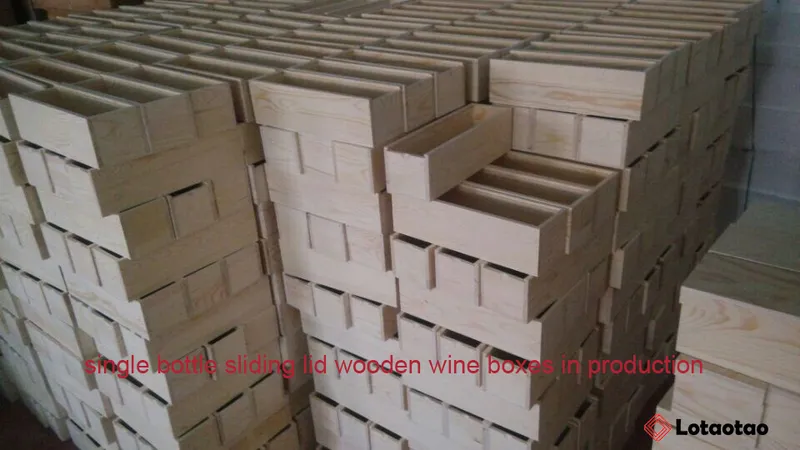
Single bottle sliding lid wooden wine boxes in production on the assembly bench

Three Formats, Three Sets of Demands

A one-bottle box is a presentation object. A six-bottle box is a small case with structural requirements closer to a crate than to a gift box, and the two should not be designed by the same set of assumptions. Most of the wine box orders that go wrong do so because the six-bottle format was priced as six one-bottle boxes built side by side.

The single-bottle box carries roughly 1.3 kg of glass and wine. The six-bottle case carries 8 kg, and that load sits on a base panel and two side walls while the case is carried by one hand at the midpoint. The lid has to resist the case racking into a parallelogram. The base has to carry a point load where the bottles sit, not an even one. None of that shows up in a drawing that only specifies outside dimensions.

The production line treats them as different products. The single-bottle box runs on the same cell as a gift box. The six-bottle case gets its own jigs, a heavier base, and a longer clamp time.
Sliding Lid or Hinged Lid

The sliding lid suits a box that is opened once and kept. It has no hardware, no hinge screws to pull out of a 9 mm wall, and the whole lid lifts away so nothing obscures the bottle. The groove needs 0.3–0.5 mm of clearance and the lid needs a finger pull deep enough to grip with a thumb — 20 mm wide, 10 mm deep is the minimum that works with a wine bottle inside.

The limitation is access. A sliding lid on a six-bottle case needs 400 mm of clear bench in front of the box to open, and a retailer displaying on a shelf does not have it. That is why the six-bottle format almost always goes hinged.

A hinged lid on a wine box uses two or three butt hinges, 50–76 mm long, set into mortises cut on the CNC before assembly. The lid stays attached, the box opens on a shelf, and the bottles lift out vertically. The cost is hardware and alignment: a hinge mortise 0.5 mm deep on one side and 0.8 mm on the other tilts the lid, and a tilted lid on a six-bottle case leaves a visible gap along 400 mm. Hinges are set on a jig referenced from the finished frame, not from the panel drawing.

For a two-bottle box either works. The deciding question is whether the box is a gift that gets carried home or a retail unit that gets opened repeatedly. Carried home: sliding. Opened on a shelf: hinged.

Dividers, Cradles and the Clearance That Stops Rattle

Bottle dimensions drive the internal layout. A standard Bordeaux bottle measures about 76 mm across the body; a Burgundy bottle runs 78–80 mm. Champagne and some New World bottles are wider still. The box has to be specified against the actual bottle, not against "standard wine bottle," which does not exist.

Dividers are 6–9 mm plywood or solid stock, set in grooves 3 mm deep in the base and the lid rail. A divider that stops at the bottle shoulder lets the bottles lean into each other and the labels scuff. A divider that runs full height, slotted into both base and lid, also acts as a structural rib and stiffens a six-bottle case considerably.

The cradle — the shaped block or routed recess the bottle lies in — is cut to the bottle contour plus 1.5–2 mm. Total lateral clearance around the bottle body should land at 3–5 mm. Tighter than 3 mm and the box will not close on a bottle whose label sits 0.4 mm proud; looser than 5 mm and the bottle moves in transit, which is what produces broken necks in a case that was packed correctly.

Neck support matters as much as body support. A bottle supported only at the base and the body bears its whole weight at the neck when the case is tipped, and the neck is the weakest part of the package. A cradle block under the shoulder, 20 mm thick, takes that load. On a six-bottle case the blocks align on a common rail so the load transfers to the base, not to the divider.

Pine, Paulownia, Plywood

Pine is the default for a painted or clear-finished wine box. It machines cleanly, takes a brand iron well, and holds a hinge screw. Density runs about 500–560 kg/m³ depending on species, so a six-bottle pine case weighs roughly 3.5–4 kg empty. That weight is the cost driver: at 2026 air freight rates of $5–7 per kg to the US, a case that is 1 kg heavier costs about $6 more to fly, which is more than the material difference between pine and paulownia.

Paulownia weighs about 40 percent less than pine, at roughly 260–300 kg/m³. A six-bottle paulownia case comes in around 2.2 kg. It machines well, engraves with a clean edge, and takes a water-based finish without blotching. It is softer than pine — a fingernail leaves a mark — so it suits a box that travels inside a carton and not one that gets stacked loose on a pallet.

Plywood is the structural choice. A 9 mm poplar-core plywood panel at 450–550 kg/m³ is stiffer than solid pine of the same thickness and does not move with humidity, which matters on a 400 mm six-bottle lid. The face veneer carries the finish; the core carries the load. On a large case, a plywood base and dividers with solid pine or paulownia sides is the usual compromise, and it is the one we recommend when the case will ship as its own carton.

Our wood materials guide has the density and stability figures if you are comparing specifications between suppliers.

Can the Wine Box Double as the Shipping Carton?

Usually not, and the reason is mechanical rather than commercial. A wooden box has no cushioning. Drop it from 800 mm onto a corner — the standard handling event for a parcel — and the deceleration transmits straight into the bottle. Corrugated absorbs that energy by crushing; a 9 mm pine wall does not crush, it transmits. The bottle breaks inside an intact box, which is the worst outcome for a claim.

What a shippable wine box needs instead:

  • A master carton with 25–30 mm of corrugated or moulded pulp between the wooden box and the carton wall, and the box immobilised so it cannot shift.
  • Neck and base blocking inside the box, so the bottle cannot move relative to the timber.
  • A base that carries the load in the direction it is actually applied — a six-bottle case needs either a 12 mm base or two 20 × 30 mm rails under it, because the base panel spans 400 mm and sags under 8 kg in a humid container.
  • ISPM-15 compliance if the box is packaging. Solid wood thicker than 6 mm used as shipping packaging needs heat treatment at 56°C core for 30 minutes, or methyl bromide fumigation, plus the IPPC stamp. Plywood, MDF and OSB are exempt.

That last point trips up buyers regularly. A wine box sold as a retail product and packed inside a carton is cargo. A wine box used by the winery as the outer shipping container is packaging, and the ISPM-15 stamp has to be on it. The distinction is about how the box enters the country, not about what it is made of.

Branding for Wineries and Distributors

Three methods cover nearly all wine box branding, and each has a different cost curve.

Laser engraving cuts 0.3–0.8 mm into the surface with a CO2 laser. It gives fine detail — a crest, a vintage, a signature line — and needs no consumables. On pine the engraved area darkens with the char; on paulownia it stays lighter and the contrast is lower, so the artwork needs more line weight. Setup is a file, not a die, which makes laser the right choice for short runs and for personalised bottles. Cycle time is 40–90 seconds per lid at this size.

Brand iron presses a heated brass die into the timber for 2–4 seconds at 150–200°C. It produces a debossed, scorched mark with a tactile edge that reads as traditional cooperage. The die costs $60–200 and lasts for tens of thousands of impressions. It is the cheapest per unit above roughly 2,000 pieces, and the most expensive way to brand 50.

Screen print lays 1–4 colours of solvent or UV ink onto a sealed surface. It handles fine typography and colour that engraving cannot, and it must go on after the sealer coat, not before. Adhesion is tested by cross-cut on the same batch. On an unsealed box the ink wicks into the grain and the edges blur, which is why screen-printed boxes are always finished first.

Branding position follows the format. On a sliding lid the mark goes on the lid face, clear of the finger pull. On a hinged case it goes on the lid top or is split between the lid and the front panel. Our logo branding guide covers artwork preparation for each method, including the line weights that survive a brand iron.

Finishes That Do Not Mark Labels or Smell of Solvent

A wine box has an unusual finishing constraint: the surface sits against a paper label for months, and the box is opened in a room where people are tasting wine. A finish that off-gasses solvent or migrates oil into the label fails both tests.

Water-based acrylic and water-based PU systems are the default for this reason. Total film is 80–160 μm, VOC stays under 100 g/L, and the finish is odour-free once cured. Solvent PU gives a harder, fuller film and better resistance to handling, but it needs 48 hours of cure plus a deodorising pass before packing, and the isocyanate smell lingers in a closed box longer than the production schedule usually allows.

Two rules keep the labels clean. First, the interior is either left unfinished or finished with the same water-based clear — never with an oil that migrates. Second, the box is fully cured before the bottle goes in: 24 hours minimum for water-based, 7 days for a two-pack PU. A box packed at 12 hours traps solvent vapour against the label, and the label cockles within a week.

Hard-wax oil is the right choice for an open-grain, natural look on paulownia. It leaves the timber matte and touchable and adds almost no film, so the engraving stays crisp. It offers less protection against a spilled glass, and it needs a top-up in service, which the winery should know before it goes on a tasting room shelf.

Gloss level matters for photography more than for durability. A 20–40 degree semi-matte hides handling marks on a dark stain; a high gloss shows every fingerprint. Most winery buyers land on semi-matte for that reason.

The Production Sequence, With Timing

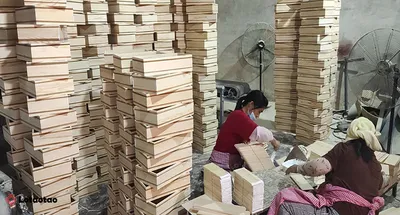
A 5,000-piece run of single-bottle sliding lid boxes in pine, clear water-based finish, laser engraved, runs about 14 working days from material release to pallet. A six-bottle hinged case adds four days, mostly in assembly and clamp time.

Stage Days What happens
Material release 1–2 Lumber checked for species, grade, moisture; acclimated to the destination target
Cutting and machining 3–4 Panels dimensioned, grooves and hinge mortises cut, cradles routed
Glue-up 5 Frames closed with D3 at 0.8–1.2 MPa; 45–90 minutes in the press
Cure and rest 6–7 24–48 hours before sanding and hardware
Sanding 8 P40–P60 through P280–P320, edges by hand
Finishing 9–10 Sealer, sand, two topcoats; 24 hours between coats
Branding 11 Laser, brand iron or screen print after the sealer
Hardware and fit 12 Hinges, latches, lid fit, cradle blocks
Inspection and packing 13–14 AQL sample, 100 percent visual, carton with corner protection

The six-bottle case differs in three places. Clamp time goes to 90 minutes because the frame is 400 mm across and the joints carry more load. The base gets a rail or a 12 mm panel. The lid gets a stiffener or a plywood core, because a solid pine lid at 400 mm will cup across the width within a season in a dry market.

Racking is the failure to design against on the large format. Pick a loaded six-bottle case up by one end and the frame wants to become a parallelogram; the dividers, if they are slotted into both base and lid, are what stop it. A case built with dividers that sit loose in the base looks identical on the bench and fails in the second year of service.

If you are specifying a wine box for the first time, our wooden wine boxes page shows the formats and internal layouts we build most, and the plant-level manufacturing overview covers the inspection gates every order passes through.

Frequently Asked Questions

How much clearance should a wine bottle have inside a wooden box?+

Aim for 3–5 mm total lateral clearance around the bottle body. Under 3 mm the box will not close on a bottle whose label sits slightly proud; over 5 mm the bottle shifts in transit and the neck takes the impact. Measure against the actual bottle, since Bordeaux runs about 76 mm and Burgundy 78–80 mm across the body.

Can a wooden wine box be shipped without an outer carton?+

It ships, but breakage rates climb. A 9 mm pine wall transmits drop energy instead of absorbing it, so an 800 mm corner drop breaks the bottle inside an intact box. A shippable version needs 25–30 mm of corrugated or moulded pulp around it, neck and base blocking inside, and a base reinforced with rails or a 12 mm panel.

Is paulownia or pine better for wine boxes?+

Paulownia weighs about 40 percent less — roughly 260–300 kg/m³ against 500–560 for pine — which matters on air freight and on a six-bottle case carried by one hand. Pine is harder, holds a hinge screw better and resists stacking damage. Most buyers use paulownia for presentation boxes that travel in cartons and pine or plywood where the case takes handling.

Do wooden wine boxes need ISPM-15 treatment?+

It depends on how the box enters the country. A box sold as retail product and packed inside a carton is cargo and exempt. A box the winery uses as the outer shipping container is solid wood packaging thicker than 6 mm, so it needs heat treatment at 56°C core for 30 minutes or methyl bromide fumigation, plus the IPPC stamp. Plywood and MDF are exempt either way.

Which finish keeps a wine label from cockling?+

A fully cured water-based acrylic or water-based PU, with the interior left unfinished or given the same clear coat. Pack only after the cure is complete — 24 hours for water-based, seven days for two-pack PU. Solvent vapour trapped in a closed box migrates into the paper and cockles the label within a week.

Related Pages

Need This Made to Your Spec?

We manufacture custom wooden boxes, crates, trays, and pet furniture in our own factory in China. Send your drawings or samples for a quote.

Request a Quote →