
Lotaotao Logo
Product Guides

Wooden Keepsake Box with Combination Lock: Design and Sourcing

A product guide to wooden keepsake boxes with combination locks: which lock to specify, how it is mortised, lid and hinge construction, lining, and the tests that matter.

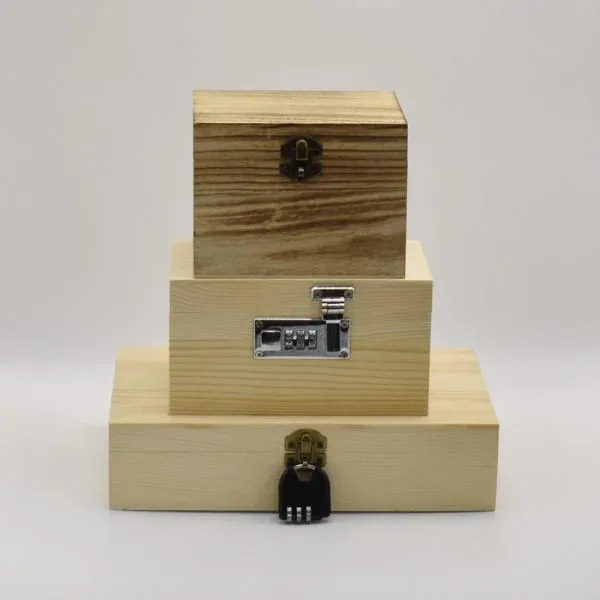
Wooden keepsake box with a three-digit combination cam lock and velvet lined interior

What Goes Inside a Keepsake Box

A keepsake box holds something a person will not throw away. That single fact sets the specification more than any style reference.

Four uses cover the category. A memory box holds photographs, letters, a first tooth, a lock of hair; the usual size is 300 × 200 × 120 mm with a removable tray. An urn box holds cremains in a sealed inner bag; 200 × 150 × 150 mm with a 0.5 mm PET bag, and the lid gasket matters more than the lock. A gift box holds a watch, a pen, or a piece of jewelry; 250 × 180 × 80 mm with a foam or velvet insert. A valuables box holds a passport, coins, or heirlooms; 300 × 220 × 100 mm with a lock that a child cannot open in a minute.

The use decides the lock. A child's memory box suits a three-digit dial that the child can learn and reset. An urn box suits a keyed cam lock, because a family does not want to explain a combination to every relative who visits. A gift box suits a hasp or a low-profile dial that photographs well. A valuables box suits a four-digit dial with 10,000 combinations.

Write the use on the drawing. It changes the lid thickness, lining, hinge, and lock, and a factory that knows the use flags conflicts before the sample is cut. The wooden jewelry boxes range shows the sizes and interiors that carry over to keepsake work.
Why a Combination Lock, and Why It Is Not a Safe

A combination lock solves three problems. There is no key to lose, which matters for a gift that travels. It is giftable, because a dial on a wooden lid looks like a secret. It is child-resistant, which keeps a six-year-old out of a box of letters.

It is not child-proof, and it is not security. A three-digit dial has 1,000 possible combinations; a patient eight-year-old works through them in about 20 minutes. A four-digit dial has 10,000, which is enough to stop casual curiosity and nothing more.

Say this plainly in the listing. A wooden keepsake box with a combination lock is not a security container. The lid is 12–18 mm of pine, walnut, or cherry, the cam is a 20 mm stamped steel tab, and there is no steel liner, no relocker, and no fire rating. A flat pry bar opens the lid in seconds, and the hinge is the first thing to fail. No wooden box in this category carries a UL 1037 or EN 14450 rating, and a supplier who claims one is describing a different product.

The words to use are privacy, keepsake, and gift. The words to avoid are secure, safe, lockbox, and fireproof. A brand that markets the box as a safe invites a return, a chargeback, and a complaint that the product failed a job it never had. If a customer needs real security, sell a steel document box and keep the wooden box for what it does well.

The lock still has to work. A dial that sticks or a cam that misses the strike produces the same return as a broken hinge.

Lock Hardware Options

Five hardware families cover the category, and the combination lock storage boxes we build show the standard assemblies. Unit costs below are for 1,000 pieces, zinc alloy body, chrome or black nickel finish.

TypeCombinationsMountingUnit cost at 1,000Best for
3-digit dial cam lock1,00019 mm hole through the lid$1.20–3.50Memory box, gift box
4-digit dial cam lock10,00019 mm hole, 50 mm escutcheon$2.50–6.00Valuables, adult keepsake
Resettable cam lock1,000 or 10,00019 mm hole$2.00–5.00Branded gift, hotel-style
Keyed cam lockNot applicable19 mm hole$0.60–1.50Urn box, institutional
Hasp and padlockPadlock dependentSurface screw$0.30–0.80 plus padlockUtility, shipping, rustic

A cam lock cylinder comes in three common lengths. A 5/8 in (16 mm) body fits a 9–12 mm panel; a 3/4 in (19 mm) body fits 15–18 mm; a 7/8 in (22 mm) body fits 20–25 mm. Order the cylinder to the lid thickness. Too short leaves the cam behind the strike; too long bottoms out and the escutcheon stands off the wood.

Resettable locks are worth the extra dollar for a gift brand. The customer sets the code from the factory default, and the brand does not have to print a code card or keep a master list. The reset procedure happens with the lid open, using a pin through the back of the body, so it cannot be changed by someone who does not already know the code.

A hasp and padlock is the cheapest option and the least giftable. Shipping a padlock adds weight, a metal part that customs may question, and a second supplier. Keep it for utility boxes. On a retail gift box, the lock is part of the object; a $2 dial reads better than a $0.50 hasp.

Installing the Lock: Mortise, Strike Plate, Lid Thickness

The lock is only as good as the hole it sits in. Most failures in returned samples are installation errors, not hardware defects.

Minimum lid thickness for a mortised cam lock is 18 mm. At 15 mm, add a reinforcement block: 60 × 60 × 12 mm maple or beech, glued with PVAc D3 and fixed with two 3.5 × 16 mm screws behind the lock body. The block spreads the load, stops the lid splitting when the cam is turned against a full box, and gives the cylinder something to clamp. Below 12 mm, use a surface-mount hasp instead. A mortised lock in a 10 mm lid will split within a season.

Drill a 19 mm (3/4 in) hole through the lid front face, centred 12–15 mm from the edge. The mortise depth equals the cylinder length minus 1.5–2 mm, so the escutcheon sits flush and the cam clears the strike without rubbing. Test the fit with a scrap piece of the same species; pine compresses, walnut does not, and the same hole gives a different feel in each.

The cam needs 1.5–2 mm of overlap behind the strike. More overlap and the lid binds when the box is full; less and the lid opens with a shake. Mount the strike plate, 20 × 40 × 1.5 mm steel with a 3 mm slot, with two 3 × 12 mm screws into 2 mm pilot holes. Align the slot with the cam at 90°, then open and close ten times before the glue on the block is allowed to cure.

Hole position tolerance is ±0.3 mm. A hole 1 mm off-centre leaves a lid proud on one side, and no hinge adjustment hides it. Drill on a jig and check the first piece of every batch against the sealed sample.

The hinges take the reaction load from the lock pulling the lid down. Two hinges carry a 300 mm lid; a 400 mm lid needs three, or a piano hinge.

Lid Construction and Hinge Choice

A keepsake box is opened more than it is carried. The hinge is the part that wears.

Butt hinges in brass or stainless steel are the standard. A 50 × 30 mm (2 in) pair carries a lid up to 5 kg; a 63 × 35 mm (2.5 in) pair carries up to 10 kg. Mortise each leaf 1.5 mm deep and set it 2 mm from the back edge. Screws are 3 × 12 mm with a 2 mm pilot in hardwood and a 2.5 mm pilot in pine. A screw driven without a pilot splits a 15 mm lid, and the split appears at the top edge where everyone sees it.

A piano hinge is the better choice above 400 mm. The continuous leaf distributes the load along the full width, so the lid does not sag at the ends, and it takes the torsion of a lid opened from one corner. It costs $2.50–5.00 and adds 5–8 minutes of assembly. For a box sold as an heirloom, the piano hinge is the honest specification.

A lid stay or a 90° stop chain belongs on any lid over 300 mm. It costs $0.80–1.80 and stops the lid falling back on fingers. On a box with a combination lock, a falling lid also puts load on the cam and the strike, which is the wrong place for it.

Felt or EVA bumpers, 3 mm, at the two front corners do three jobs: they stop the lid rattling, they leave 0.5 mm of clearance for the lid to settle, and they let air move so the lid does not stick in a humid room. A lid with no bumper and a tight reveal becomes a lid that needs a knife to open in August.

Lid reveal is 0.5–1.0 mm all round. Below 0.5 mm the finish thickness closes the gap; above 1.0 mm the box looks out of square. Check it with a feeler gauge at four points, not by eye.

Interior, Wood, and Finish

A lining that lifts at the corner ruins a keepsake box faster than a scratch on the lid.

Velvet or suede over 2 mm foam is cut and glued by hand: 8–15 minutes and $0.80–2.00 per box. Use a water-based adhesive applied thin, and wrap the corners before the adhesive grabs. A removable tray in 3–5 mm ply with a ribbon pull adds $0.60–1.50 and a second layer. For a watch or a pen, a die-cut foam insert holds the object better than loose fabric. A 60 × 20 mm brass or anodized aluminum engraving plate, inset 1 mm into the lid lining, gives the buyer a place for a name, a date, or a short message without engraving the wood. The box lining guide covers foam grades and corner folds.

Wood choice changes weight and perceived value more than any other decision. Walnut at 610 kg/m³ gives a 300 × 200 × 120 mm box with 12 mm walls a weight of about 2.2 kg including hardware. Cherry at 560 kg/m³ gives about 2.1 kg. Oak at 700–755 kg/m³ gives about 2.4 kg and feels the heaviest in the hand. Pine at 400–500 kg/m³ gives about 1.8 kg and reads cheaper unless it is painted. Paulownia at 300–350 kg/m³ gives about 1.4 kg; it needs a full lining to feel substantial, and it dents at a fingernail.

Walnut and cherry darken with light and photograph well. Oak is hard, heavy, and open-grained. Pine takes paint and print but shows knots. The wood materials guide lists density and shrinkage by species.

Finish: water-based lacquer at 50–100 g/L VOC or hard wax oil below 50 g/L. Solvent polyurethane at 400–600 g/L leaves a harder film and a smell that lingers inside a closed box. A gift box opened at a wedding should not smell of solvent. Cure 48–72 hours before lining and packing, and sand to P120, P180, P240, then P320 before the topcoat. Gloss 20–40 suits a keepsake box; a full gloss shows every fingerprint.

Testing Before You Ship

Test the hardware, the lid fit, and the packed box. A sample that passes on a bench in controlled conditions still fails in a container.

Lock cycle. Run 1,000 open and close cycles on five units at 10 cycles per minute. Check cam wear, code drift, escutcheon looseness, and screw torque every 200 cycles. Acceptance: no failure, cam overlap of at least 1.5 mm at the end, and no visible wear through the plating. A line sold as an heirloom should run 5,000 cycles.

Hinge cycle. Open the lid to 100° and close it 1,000 times. Check screw tightness and lid sag. Acceptance: sag of 1 mm or less, no screw pulled, no crack at the hinge mortise.

Drop test. Pack the box as it ships and run ISTA 1A: ten drops from 760 mm (30 in) onto one corner, three edges, and six faces. Inspect the lid alignment, lock function, corner joints, and lining. A box that opens on a drop has failed, even if the wood is intact.

Humidity. Hold the box at 40°C and 90% RH for 72 hours, then condition at 23°C and 50% RH for 24 hours. Acceptance: lid gap change of 0.5 mm or less, no binding, no mould on the lining, no blush on the finish. This catches the lid that fits in January and jams in July.

Production inspection. AQL 2.5 for major defects and 4.0 for minor, with 100% lock function testing. Keep five units from each lot for 12 months. When a customer reports a stiff dial, the retained sample shows whether the lot changed or the customer did.

What to Specify When Ordering

A purchase order for this product needs eleven lines. With all eleven, a factory quotes and samples without a week of email.

  • Outside dimensions and tolerances: ±0.5 mm on panels, ±1.0 mm on the box.
  • Wood species and grade, including the knot rule for visible faces.
  • Moisture content for the destination market: 6–10% US, 8–12% northern Europe, 12–16% Southeast Asia.
  • Lock type, combination count, finish (chrome, black nickel, brass), and reset method.
  • Lid type and hinge: butt, piano, or lift-off, with the hinge finish.
  • Lining fabric, colour, foam thickness, and whether the tray is removable.
  • Engraving plate: size, material, and position.
  • Finish system, sheen, and colour reference.
  • Packaging: foam, carton, drop-test standard, and retail labelling.
  • Compliance: CARB, REACH, FSC, and any food-contact statement.
  • Quantity, delivery date, and Incoterm.

MOQ is 200–500 for a standard box and 500–1,000 for a custom size, lining, or lock finish. A custom-colour lock needs 1,000 pieces and 25–35 days on its own. Production runs 25–35 days after sample approval; a sample takes 7–15 working days; sea freight adds 25–35 days to the US West Coast.

Budget at 500 pieces: $6–18 FOB for a 300 mm lined box, with the lock adding $1.20–6.00, the lining adding $0.80–2.00 in labour, and a piano hinge adding $2.50–5.00. Ask for the lock supplier's test report and ISO 9001 certificate with the first order. The custom order process lists the drawings and approvals at each stage, and the contact page is the place to send a reference photo and a target price.

Frequently Asked Questions

Is a wooden box with a combination lock secure?+

No. It keeps a child or a casual visitor out of a keepsake box; it does not stop a determined adult. The lid is 12–18 mm of wood with a stamped cam and no steel liner, relocker, or fire rating. A pry bar opens it in seconds. Sell it as a privacy box or a gift box, never as a safe or a lockbox.

How many combinations does a combination lock have?+

A three-digit dial has 1,000 combinations. A four-digit dial has 10,000. A resettable cam lock uses the same dial and lets the owner set a new code with the lid open. Three digits suit a child's memory box; four suit an adult keepsake or a valuables box where casual curiosity is the concern.

What lid thickness does a combination cam lock need?+

A mortised cam lock needs an 18 mm lid. At 15 mm, add a 60 × 60 × 12 mm hardwood reinforcement block behind the lock, glued with PVAc D3 and screwed. Below 12 mm, use a surface-mount hasp instead. A mortised lock in a 10 mm lid splits within a season, usually at the top edge.

Can the combination be changed by the customer?+

Yes, with a resettable cam lock. The owner opens the lid, presses a reset pin through the back of the body, sets the new code, and releases the pin. The procedure happens with the box open, so someone who does not already know the code cannot change it. Order the resettable version if the box is a gift.

How is the lock and hinge tested before shipping?+

We cycle the lock 1,000 times on five units and the hinge 1,000 times, checking cam overlap, screw torque, and lid sag. The packed box runs an ISTA 1A drop test from 760 mm, and a humidity test at 40°C and 90% RH for 72 hours. Acceptance is a lid gap change of 0.5 mm or less and no binding.

What is the MOQ for a custom keepsake box with a lock?+

200–500 pieces for a standard box, 500–1,000 for a custom size, lining, or lock finish. A custom-colour lock needs 1,000 pieces and adds 25–35 days. Production takes 25–35 days after sample approval, and a sample takes 7–15 working days. Mixed sizes can share a minimum if the wood and finish match.

Related Pages

Need This Made to Your Spec?

We manufacture custom wooden boxes, crates, trays, and pet furniture in our own factory in China. Send your drawings or samples for a quote.

Request a Quote →